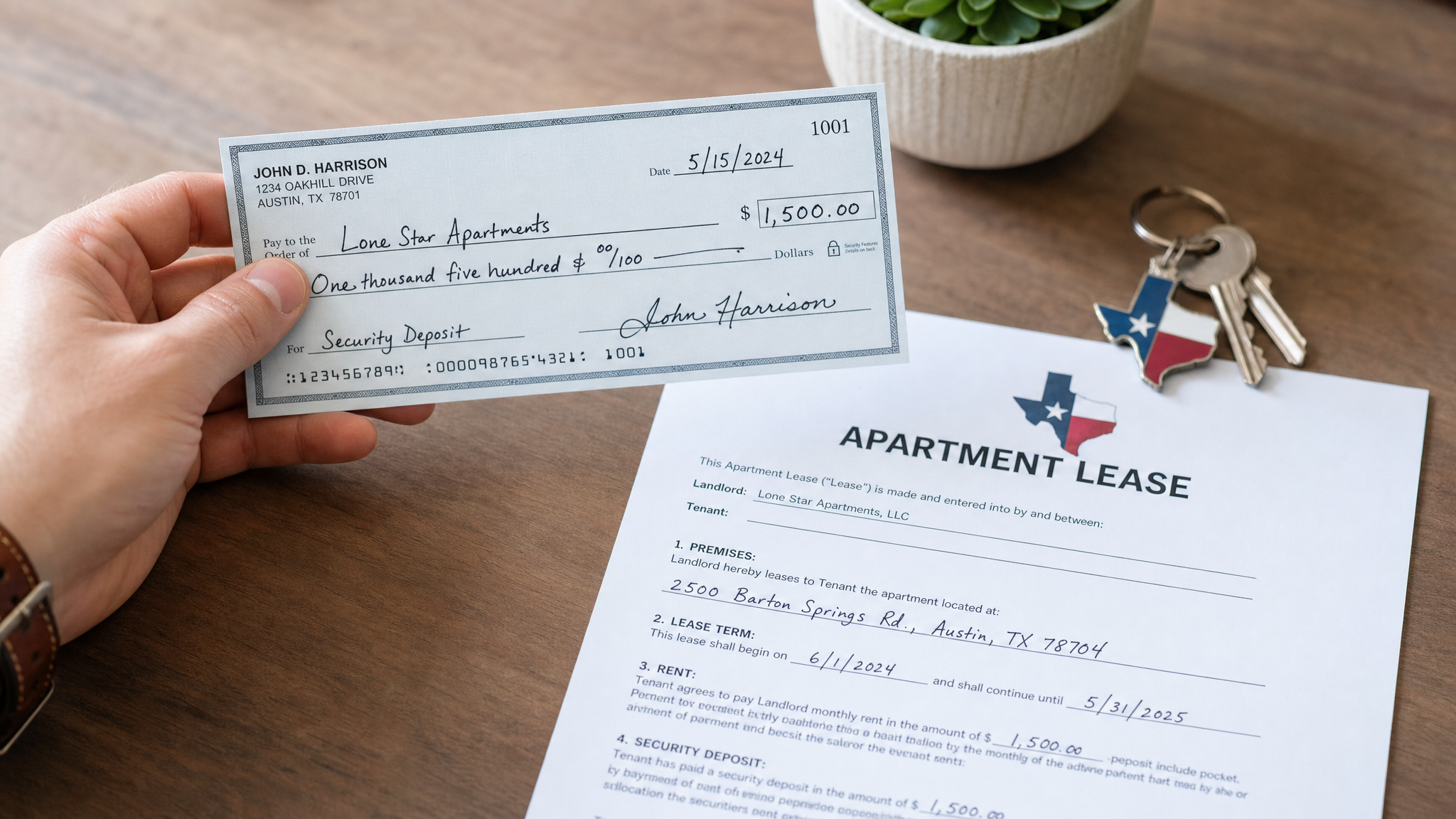
The 30-Day Rule — Texas Property Code § 92.103
Under Texas law, your landlord must return your security deposit — or mail you a written, itemized list of deductions with any remaining balance — within 30 days after you vacate and surrender possession of the unit. This clock starts when you both vacate AND provide a forwarding address.
What Can a Landlord Legally Deduct?
Section 92.104 limits deductions to specific categories only. Your landlord cannot simply keep your deposit because they feel like it. Legal deductions include:
- Unpaid rent at the time of move-out
- Damages beyond normal wear and tear — holes in walls, broken fixtures, burns, pet stains
- Charges expressly authorized in the lease — cleaning fees, early termination fees (if in writing)
- Unreturned keys or access cards (if the lease specifies a charge)
The Itemized List Requirement
If your landlord makes ANY deductions, they must send you a written, itemized statement explaining each deduction and the amount. A vague "cleaning fee" with no breakdown is legally insufficient. The statement must be mailed to your forwarding address.
If the landlord keeps any portion of your deposit without providing this itemized statement within 30 days, they lose the right to keep it — and face treble damages.
📜 Tex. Prop. Code § 92.104(c)Penalties for Wrongful Withholding — § 92.109
This is where Texas law has real teeth. A landlord who in bad faith withholds your deposit can owe you:
- The full amount wrongfully withheld
- An additional $100 penalty
- Three times the amount wrongfully withheld (treble damages)
- Your reasonable attorney's fees
Real Court Case: Bad Faith Deposit Withholding
In Pulley v. Milberger, 198 S.W.3d 418 (Tex. App.—Dallas 2006), the Dallas Court of Appeals affirmed that a landlord's failure to timely return a deposit or provide an itemized statement supports a finding of bad faith — entitling the tenant to treble damages under § 92.109. The court noted that the landlord bears the burden of proving good faith when they withhold any portion.
In a companion line of cases, Texas courts have consistently held that a landlord cannot escape liability by simply claiming the unit needed cleaning if they cannot produce receipts, photos, or a move-out inspection report documenting the actual damage.
How to Sue in DFW — Justice of the Peace Court
Security deposit disputes in Dallas-Fort Worth are filed in Justice of the Peace (JP) Court. You can sue without an attorney for amounts up to $20,000. Filing fees run approximately $46–$96 depending on the precinct.
| County | Court | Filing Location | Phone |
|---|---|---|---|
| Dallas County | JP Court Pct. 1–8 | 600 Commerce St, Dallas, TX 75202 | (214) 653-7638 |
| Tarrant County | JP Court Pct. 1–8 | 200 Taylor St, Fort Worth, TX 76196 | (817) 884-1400 |
| Collin County | JP Court Pct. 1–4 | 2100 Bloomdale Rd, McKinney, TX 75071 | (972) 548-4100 |
| Denton County | JP Court Pct. 1–5 | 1450 E McKinney St, Denton, TX 76209 | (940) 349-2012 |
Step-by-Step: Getting Your Deposit Back
- Provide your forwarding address in writing before move-out — email or text with timestamp works.
- Do a walkthrough with your landlord and photograph every room — walls, floors, appliances, fixtures — with time-stamped photos.
- Wait for the landlord's response. They have exactly 30 days from the date you vacated AND gave your address.
- If no response or improper deductions, send a certified demand letter stating the amount owed and referencing § 92.109.
- If still no response within 10–14 days, file in JP Court. Bring: your lease, receipts, move-in/move-out photos, and all written communications.
DFW Renter Statistics
Dallas-Fort Worth is one of the largest rental markets in the United States. According to U.S. Census data and the Texas Department of Housing and Community Affairs:
- Over 42% of DFW households rent their homes (approximately 1.1 million renter households)
- Median asking rent in Dallas County: approximately $1,450–$1,700/month (2024)
- Security deposit disputes are among the most common landlord-tenant cases filed in Dallas and Tarrant County JP courts
- Most deposits in DFW range from $500 to $2,500 depending on the property
Frequently Asked Questions
What if my landlord never responds to my demand letter?
Can my landlord deduct for carpet cleaning?
My landlord sent an itemized list but I think the charges are inflated. What can I do?
Does Texas law cap the amount of a security deposit?
What if I moved out early and the landlord is keeping my deposit for "lost rent"?
This guide is for general informational purposes and does not constitute legal advice. Laws may change. Consult a licensed Texas attorney for advice specific to your situation. Statute citations are to the Texas Property Code as of the date of publication.