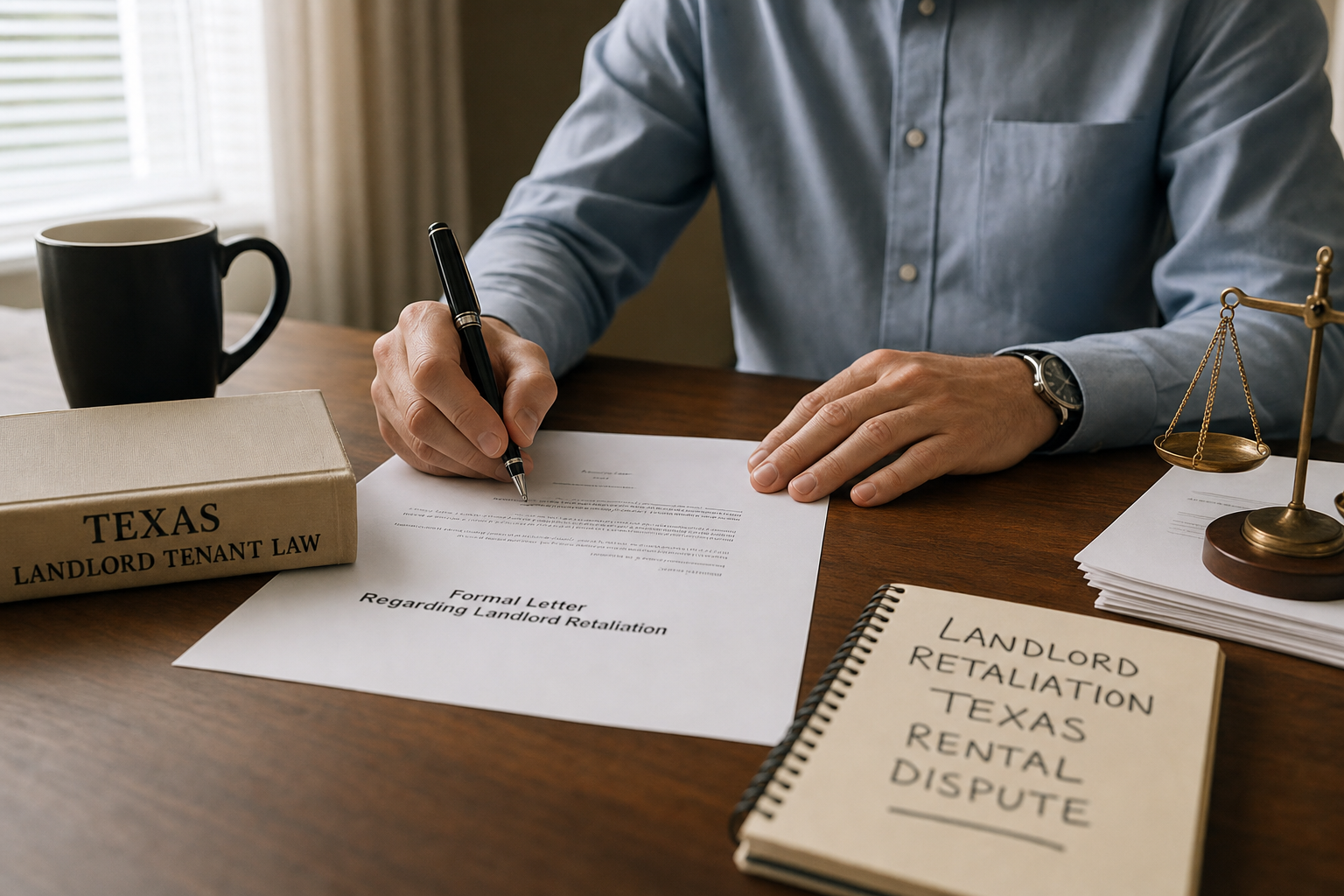
Texas law presumes retaliation if a landlord acts against a tenant within 6 months of protected activity. Tex. Prop. Code § 92.331.
What Is Landlord Retaliation? (Tex. Prop. Code § 92.331)
Retaliation occurs when a landlord takes adverse action against a tenant because the tenant exercised a legal right. Texas Property Code §§ 92.331–92.335 create a comprehensive anti-retaliation framework that protects tenants who speak up about housing conditions or organize with neighbors.
The law works in your favor: if a landlord takes action against you within 6 months of a protected activity, Texas law presumes the action was retaliatory. Your landlord must then prove the action was taken for a legitimate, non-retaliatory reason.
6 Months Presumption window under Tex. Prop. Code § 92.334 — any adverse action within this period after protected activity is presumed retaliatory
Protected Activities — What Triggers the Law
Engaging in any of the following activities gives you protected status under Tex. Prop. Code § 92.331(b):
Repair RequestsGood-faith written request for repairs affecting health or safety (§ 92.052)
Code ComplaintsReporting violations to Dallas Code Compliance, Fort Worth Code, or any city/county housing authority
Tenant OrganizingJoining or forming a tenants' union, association, or tenant organization
Legal Rent WithholdingExercising the right to deposit rent with the court or deduct repair costs (§ 92.0561)
Contacting AuthoritiesCalling 311, filing complaints with HUD, or contacting code enforcement agencies
Exercising Lease RightsAny right granted by your lease or Texas law that you exercise in good faith
DFW Focus: Filing a complaint with Dallas Code Compliance (214-671-6559) or Fort Worth Code Compliance (817-392-1234) constitutes a protected activity under § 92.331. The moment you file, the 6-month presumption clock starts. Keep your complaint reference number and screenshot confirmation.
Tex. Prop. Code § 92.331(b)(3)
What Counts as Retaliation?
Under § 92.331(a), the following landlord actions constitute prohibited retaliation:
Filing EvictionStarting an eviction proceeding or threatening eviction after protected activity
Rent IncreaseRaising rent specifically in response to your complaint or request
Service ReductionCutting utilities, removing amenities, or reducing services (parking, laundry, etc.)
Lockout or Utility CutoffChanging locks or shutting off utilities outside legal channels
HarassmentThreats, intimidation, or repeated unwanted contact designed to force you out
Non-Renewal NoticeRefusing to renew your lease specifically because you exercised a legal right
Your Remedies Under § 92.333
If you prove your landlord retaliated against you, Texas law entitles you to all of the following:
- One month's rent (regardless of actual damages)
- $500 in additional statutory damages
- Actual damages — moving costs, hotel bills, emotional distress, lost property
- Court costs and reasonable attorney's fees
- Defense in eviction proceedings — retaliation is an affirmative defense to eviction
1 Mo. Rent + $500 Minimum statutory damages for proven retaliation — plus actual damages and attorney's fees (Tex. Prop. Code § 92.333)
The 6-Month Presumption Explained
Texas' retaliation presumption (§ 92.334) is one of the strongest tenant protections in the state. Here's how it works:
- You engage in a protected activity (file a code complaint, request repairs in writing, etc.)
- Within 6 months, your landlord takes adverse action (eviction, rent hike, service cut)
- Texas law presumes the action was retaliatory — you don't have to prove the landlord's motive
- The landlord must then rebut the presumption by showing a legitimate, non-retaliatory reason
Important: The presumption can be overcome. If your landlord can show the eviction was for genuine nonpayment of rent that predated your complaint, or that the rent increase was a scheduled, across-the-board increase announced before your complaint, the presumption may not apply. Document everything with timestamps.
Tex. Prop. Code § 92.334(b)
Court Cases — Texas Retaliation Precedents
Eggemeyer v. Wilson — Texas courts have applied § 92.334's presumption strictly, placing the burden on landlords to demonstrate a legitimate business reason when adverse action follows within the statutory window. Tenants have successfully used repair request documentation and code complaint filings as the triggering protected activity.
Legislative Note (88th Legislature, 2023): Texas courts consistently hold that the anti-retaliation statutes must be liberally construed to protect tenants. Dallas County Justice of the Peace courts regularly hear retaliation claims as affirmative defenses in eviction proceedings under Tex. R. Civ. P. 510.
How to Build Your Retaliation Case
- Step 1: Document your protected activity — keep the written repair request, code complaint confirmation number, or union meeting notice with dates
- Step 2: Document the landlord's adverse action — save the eviction notice, rent increase letter, or written record of service reduction with the exact date
- Step 3: Calculate the gap — if it's under 6 months, the presumption applies
- Step 4: Send a certified demand letter to your landlord citing § 92.333 and demanding they cease the retaliatory conduct
- Step 5: File in Justice of the Peace court (small claims) for damages, or raise retaliation as an affirmative defense if they filed eviction against you
DFW Tenants: If you've been served an eviction notice in Dallas or Tarrant County and you recently filed a code complaint or repair request, do not ignore the eviction. Appear at your hearing and raise retaliation as a defense. Missing the hearing means automatic judgment for your landlord regardless of your retaliation claim.
Advertisement
Frequently Asked Questions
My landlord raised my rent right after I called code compliance. Is that retaliation?
If the rent increase came within 6 months of your code complaint, Texas law presumes it was retaliatory under Tex. Prop. Code § 92.334. Your landlord must then prove the increase was for a legitimate, non-retaliatory reason — such as a scheduled market-rate adjustment announced before your complaint. Keep your complaint reference number and the date of the rent increase notice. If the gap is less than 6 months, you have a strong starting position in court.
Can I use retaliation as a defense if my landlord files eviction against me?
Yes. Tex. Prop. Code § 92.332 explicitly allows you to raise retaliation as an affirmative defense in an eviction proceeding. You must appear at the Justice of the Peace court hearing and assert the defense — do not skip the hearing. Bring documentation of your protected activity (repair request, code complaint number) and the timeline showing the eviction followed within 6 months. Dallas and Tarrant County JP courts accept this defense.
How much can I recover if I prove retaliation?
Under Tex. Prop. Code § 92.333, a successful retaliation claim entitles you to: (1) one month's rent, (2) $500 in statutory damages, (3) actual damages including moving costs, hotel stays, lost property, and emotional distress, and (4) court costs and reasonable attorney's fees. In Justice of the Peace court (small claims), the combined monetary claims must fall within the court's jurisdictional limit (currently $20,000 in Texas JP courts).
What if I owe back rent — can I still claim retaliation?
Owing back rent does not automatically defeat a retaliation claim. However, it complicates your case. If the eviction is for genuine nonpayment of rent that predated your protected activity, the court may find it is not retaliatory. But if the landlord tolerated unpaid rent for months and only filed eviction after your code complaint, that timeline supports your retaliation claim. Courts look at the landlord's actual motivation. Pay what you owe if possible and keep retaliation as a separate claim or defense.
Do I need a lawyer to file a retaliation claim in Dallas or Tarrant County?
You do not need a lawyer to file in Justice of the Peace court (small claims), but having one strengthens your case significantly — especially since § 92.333 allows you to recover attorney's fees if you win. Legal Aid of NorthWest Texas (LANWT) at lanwt.org provides free legal help to qualifying low-income tenants in Dallas, Tarrant, Collin, and Denton counties. The Dallas Volunteer Attorney Program also offers free consultations. File your claim at the JP court in the precinct where your rental unit is located.
My landlord cut off my parking or laundry access after I complained. Is that retaliation?
Yes — reducing services, amenities, or access to facilities that were part of your tenancy constitutes retaliatory conduct under Tex. Prop. Code § 92.331(a)(3). This includes removing parking privileges, cutting off laundry access, blocking community amenities, or increasing fees not in your original lease. Document the change with photos and written communication showing when the service was removed and what protected activity preceded it.
Legal Disclaimer: This page provides general legal information about Texas landlord-tenant retaliation law for educational purposes only. It is not legal advice and does not create an attorney-client relationship. Laws may have changed; always verify current statutes at
statutes.capitol.texas.gov. For advice specific to your situation, consult a licensed Texas attorney or contact
Legal Aid of NorthWest Texas at lanwt.org (qualifying low-income tenants in DFW).